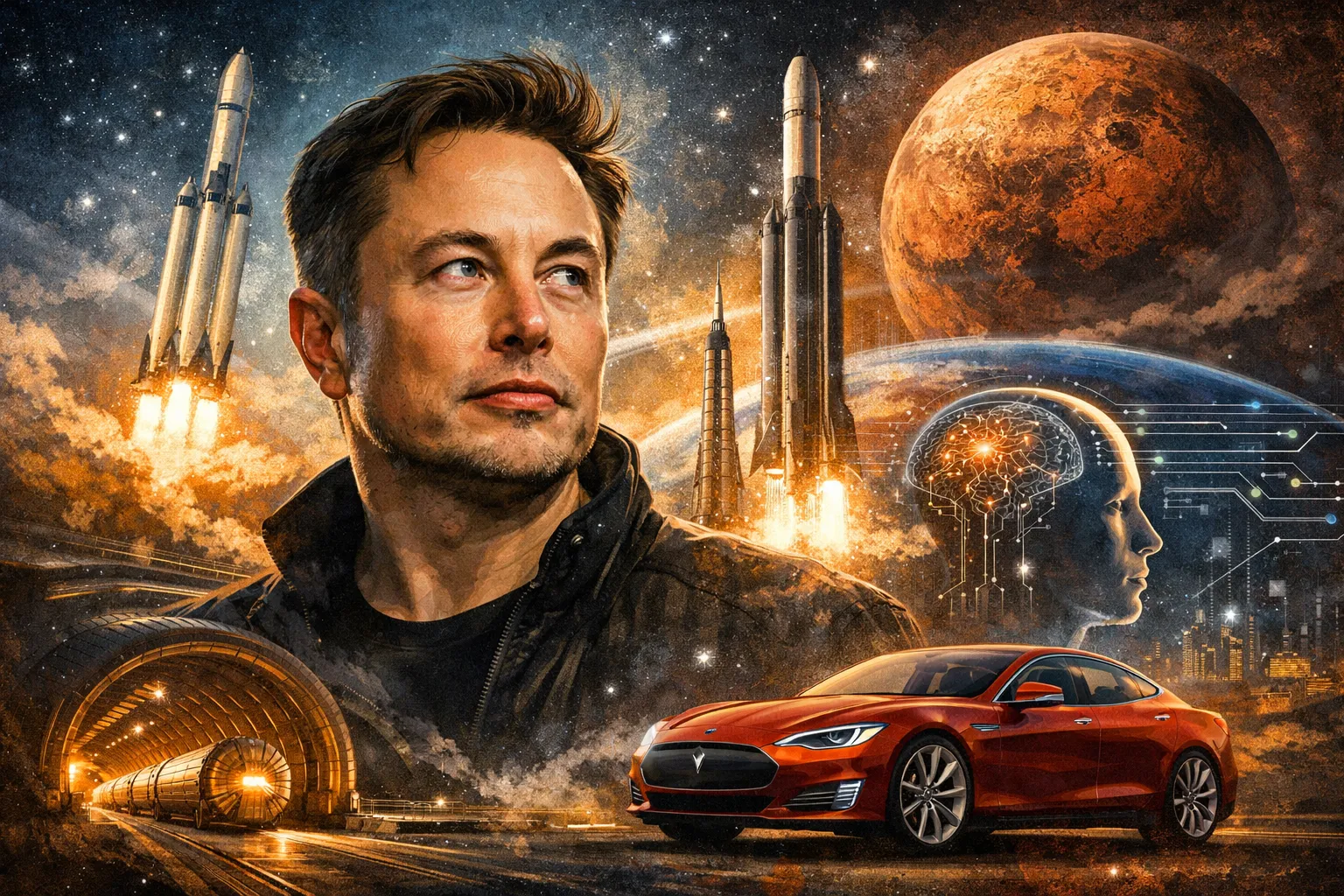
Elon Musk isn't just the world's richest man — he's a living experiment in what happens when childhood trauma, extreme intelligence, an absurd tolerance for risk, and an almost messianic vision combine in a single person. Born in Pretoria, South Africa, on June 28, 1971, he built an empire of interconnected companies — SpaceX, Tesla, Neuralink, xAI, X — that together form the most ambitious plan ever conceived by one individual: to secure the survival of the human species by making it multiplanetaryMultiplanetary A civilization that exists on more than one planet. Musk's central idea: if something catastrophic happens on Earth, humanity survives on Mars..
The boy raised by books — and then by a father who called him useless
Elon Musk's story begins with pain. The son of Maye Musk — a Canadian model and dietitian — and Errol Musk, a South African electromechanical engineer, pilot, and emerald dealer, Elon grew up in Pretoria during apartheidApartheid The system of racial segregation in South Africa (1948-1994). It separated people by skin color with laws that restricted where they could live, work, and study.. When his parents divorced in 1979, he was eight years old.
Errol Musk had what Isaacson described as a "Jekyll and Hyde nature." One minute he was friendly; the next, he launched into verbal abuse that lasted more than an hour, invariably ending by telling Elon he was "pathetic" and "useless."
At school, the picture was no better. Elon was the smallest and youngest in his class. With no social skills and no friends, he became a systematic target of bullying. In the worst incident, he was thrown down a flight of stairs and beaten until his face was unrecognizable, requiring roughly a week in the hospital.
So Elon did what he would do for the rest of his life: he took refuge in systems he could control. "I was raised by books. Books, and then my parents," he said. At nine, he read the entire Encyclopædia Britannica, spending up to ten hours a day devouring text. At ten, he taught himself to program from the manual of a Commodore VIC-20Commodore VIC-20 One of the first affordable personal computers, released in 1981. It cost less than 300 dollars and was an entire generation's gateway into programming.. At twelve, he sold his first game, Blastar, to a magazine for roughly 500 dollars.
The escape: from Canada to Stanford in two days
At 17, in 1989, Elon left South Africa to avoid the compulsory military service under apartheid. He used his mother's Canadian citizenship. Errol's last words were: "You'll never succeed."
At Queen's University in Ontario, he met Justine Wilson, his future first wife. He transferred to the University of Pennsylvania, where he completed two bachelor's degrees: Physics and Economics (Wharton). In 1995, he was accepted into Stanford's PhD program in Applied Physics. He quit after two days. The internet was exploding. With his brother Kimbal and 28,000 dollars, he founded Zip2 — sold to Compaq in 1999 for 307 million dollars.
Reasoning from atoms: how Musk thinks
If there's a single key to modeling Elon Musk, it's called first-principlesFirst principles A way of thinking that breaks problems down to their most basic truths, without accepting assumptions. Instead of "that's how it's always been," it asks "why does it have to be that way?". reasoning. Rather than reasoning by analogy — "rockets are expensive because they've always been expensive" — he breaks problems down to their fundamental truths and rebuilds from there.
The most emblematic example is the founding of SpaceX. In 2001, Musk asked the question no one was asking: "What are rockets made of?" The answer: alloys of aluminum, titanium, copper, and carbon fiber — about 2% of a rocket's final price. That ratio — which he dubbed the "idiot index" — became his obsessive metric.
This way of thinking crystallized into a five-step process Musk calls "the Algorithm":
- Question every requirement. Each one must come with the name of the person who set it — never a department.
- Delete any part or process you can. "If you don't end up adding back at least 10%, you didn't delete enough."
- Simplify and optimize. Only after deletion.
- Accelerate cycle time. Only after simplifying.
- Automate. Only last.
The semantic tree: how Musk learns (and why he learns so fast)
Musk's second cognitive pillar is his learning method. In a Reddit AMAAMA "Ask Me Anything" — an open question-and-answer session on Reddit. Celebrities and experts answer questions from anyone, live. on RedditReddit A giant online forum organized by topics (called "subreddits"). Each community discusses one subject — from science to memes. One of the biggest discussion platforms in the world. in 2015, he articulated his philosophy:
"It's important to view knowledge as sort of a semantic tree — make sure you understand the fundamental principles, i.e. the trunk and big branches, before you get into the leaves/details, or there is nothing for them to hang on to."
This explains how someone with degrees in physics and economics taught himself rocket science. Musk's trajectory is an extreme case of learning transferLearning transfer Using knowledge from one field to learn another faster. Someone who knows physics picks up engineering more easily — the fundamentals carry over.: software engineering, financial payments (PayPal), rockets (SpaceX), electric vehicles (Tesla), neural interfaces (Neuralink), artificial intelligence (xAI).
Asimov, Adams, and the meaning of life
Three science-fiction authors function as the source code of his worldview.
Isaac Asimov and the Foundation. Musk has said the Foundation series is "fundamental to the creation of SpaceX." The saga tells the story of a mathematician who predicts the collapse of galactic civilization and creates a "Foundation" to preserve knowledge.
Douglas Adams and The Hitchhiker's Guide to the Galaxy. Musk calls Adams his "favorite philosopher." The big lesson: "Often the question is harder than the answer. If you can properly phrase the question, then the answer is the easy part."
Robert Heinlein. The term "grok" — the name of xAI's chatbot — comes from Stranger in a Strange Land, where it means "to understand something so thoroughly that you merge with it."
The empire and its hidden logic
Musk's companies aren't isolated businesses — they're pieces of an integrated system. At 25, he identified three areas that would "really affect humanity": the internet, sustainable energy, and space travel.
SpaceX (2002) is the existential pillar. Musk invested 100 million dollars from PayPal and personally interviewed the first 3,000 employees. The company cut launch costs 10-fold and developed reusable rockets.
Tesla (2004) is the energy pillar. In 2006 he published the four-step "Master Plan": an expensive sports car (Roadster), an affordable sedan (Model S), a mass-market car (Model 3/Y), and clean-energy generation.
Neuralink (2016) tackles the "bandwidthBandwidth The amount of information that can be transmitted per second. Here Musk uses it as a metaphor: humans "talk" to computers very slowly compared to the speed of thought. problem" between humans and computers. In 2024, the first human patient controlled a computer with their thoughts.
xAI (2023) was Musk's response to what he sees as excessive restrictions on language modelsLanguage model An AI trained to understand and generate text. ChatGPT, Claude, and Gemini are language models — they learned from billions of texts on the internet.. The Grok chatbotChatbot A program that talks to you through text, simulating a human conversation. Virtual assistants like Siri, Alexa, and ChatGPT are chatbots. trains on real-time data from X.
The unified vision becomes clearer when you work backward from Mars: to inhabit a planet, you need transportation (SpaceX), energy (Tesla), excavation (Boring Company), robotics and AI (Tesla Optimus/xAI), communications (Starlink), and neural interfaces (Neuralink).
War mode: how Musk leads
Musk's management style is a mental modelMental model A simplified representation of how something works. Mental models help you make decisions — they're "shortcuts" for understanding complex situations quickly. worth studying — and fearing. His philosophy is Napoleonic: "He believes that wherever Napoleon was, his armies fought better." That's why he adopts a "surge attention" pattern: he pours all his energy into one company at a time during crises.
Large meetings are anathema. His rule: it isn't rude to leave a meeting if you're not contributing — what's rude is wasting people's time by staying. Musk requires software managers to spend at least 20% of their time coding.
At Twitter, he issued an ultimatum demanding "extremely hardcore" commitment — the team shrank from 7,500 to about 1,500 employees. The expectation is 80 to 120 hours of work per week.
2008: the year everything nearly ended
To understand Musk's tolerance for risk, you have to understand 2008 — the year he was, all at once, three days from bankruptcy at two companies, getting divorced, and borrowing money from friends to pay rent.
Of the 180 million from PayPal, he invested 100 million in SpaceX and 70 million in Tesla. The first three Falcon 1 launches failed. SpaceX had money for just one more launch.
On September 28, 2008, the fourth Falcon 1Falcon 1 SpaceX's first orbital rocket. Small and cheap compared to NASA's, it was the proof of concept that a private company could reach space. reached orbit. On December 23, NASA awarded a 1.6 billion dollar contract. The next day — the final hour of the last possible day — Tesla's funding roundFunding round When a company raises money from investors in exchange for a stake. If the round doesn't close in time, the company can run out of cash and go under. closed.
"He has the ability to work harder and endure more stress than anyone I've ever met. Most people under that kind of pressure fall apart. Elon becomes hyper-rational."
Demon mode, memes, and the emotional paradox
The term "demon mode" was coined by Grimes. It describes the sudden mood shifts — from functional to dark. Isaacson identified a troubling pattern: Musk manufactures crises. When things are going well, he grows restless.
At the same time, there's a genuinely fragile Musk. In 2017, his voice dropping to a whisper, he said: "When I was a child, there's one thing I said: 'I never want to be alone.' I don't want to be alone."
Musk publicly confirmed he has Asperger'sAsperger's A condition on the autism spectrum characterized by normal or above-average intelligence, difficulty with social interaction, and intense, focused interests. when he hosted SNLSNL Saturday Night Live — a live American TV comedy show, on air since 1975. Being invited to host is a cultural milestone in the US. in 2021: "I'm making history tonight as the first person with Asperger's to host SNL. Or at least the first to admit it. So I won't make a lot of eye contact with the cast tonight."
The patterns that reveal the operating system
Anyone who studies Musk finds recurring patterns that work like the operating system of his personality:
- Hyperfocused obsession. During crises, he lives at the troubled company, sleeping on the factory floor, reviewing every technical detail.
- Burning the boats. He invested all his PayPal money in two companies at once, with no safety net.
- Emotional compartmentalization. While the companies were nearly going bankrupt and his marriage was collapsing, Musk made technical decisions with glacial precision.
- Manufacturing crises. Even when everything is going well, he creates artificial urgency.
- Impossible deadlines as a forcing function. He routinely halves his engineers' most optimistic estimates.
- Repeating the paternal pattern. Isaacson noted that Musk developed some of his father's traits. Maye Musk said: "The big danger for Elon is that he becomes his father."
The impossible question
To model Elon Musk is to accept that his greatest flaws and his greatest strengths spring from the same source. The traumatic childhood that left him emotionally dysregulated is the same one that gave him superhuman tolerance for pain and risk. The Asperger's that makes him socially awkward is the same thing that lets him focus with an almost pathological intensity.
Musk's most revealing line may be the simplest: "I'm wired for war, basically." He doesn't know how to stop. He doesn't know how to savor victories.
The question Isaacson leaves the reader remains open: can the traits that make Musk capable of extraordinary feats be separated from the ones that make him destructive? Or is it impossible to pull out the dark threads without unraveling the whole fabric? The answer, as Musk learned from Douglas Adams, may depend less on the answer itself and more on whether we're asking the right question.